Dell 3.5-inch caddy + HDD in a 10-inch rack
The Dell PowerEdge 3.5-inch drive caddy in a 10-inch rack: two per printed 1U hot-swap mount, 198 mm deep, fits every frame. Drive specs unverified.
On this page
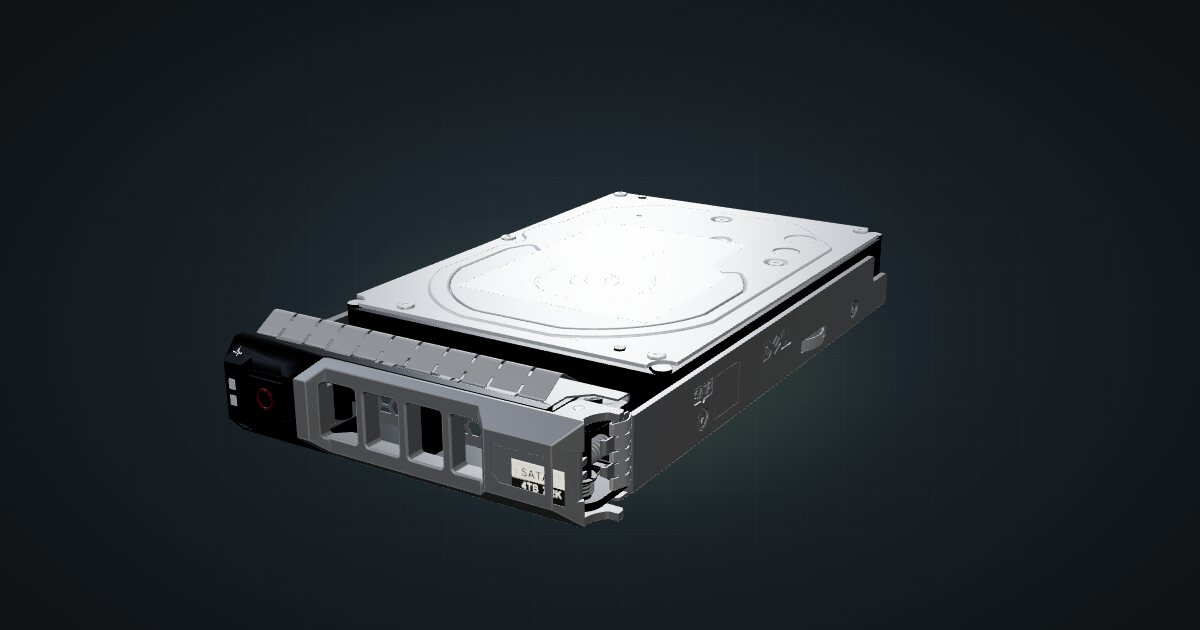
This is a Dell PowerEdge 3.5-inch hot-swap drive tray with a hard drive in it, the same kind of sled that slides into the front of a Dell server. In a mini rack it is the drive carrier for the community’s printed dual 3.5-inch hot-swap mount, two trays side by side in 1U. It suits a homelab that wants spinning-disk capacity that swaps from the front, without buying a NAS chassis.
At a glance
| Form factor | 3.5-inch LFF hot-swap tray for Dell PowerEdge |
| Drives | SAS or SATA, one 3.5 × 1-inch drive per tray |
| Compatibility | PowerEdge 13th gen, backward compatible with 11th/12th gen (retailer listing) |
| Size | 111.3 × 190.1 × 29.7 mm with drive and handle, measured from the CAD model |
| Rack mount | Dual 3.5-inch HDD mount: 1U, 198 mm deep, two bays |
| Power | Not specified; depends entirely on the drive |
Where it fits in a mini rack
The caddy is the front end of a storage shelf, not a storage device in its own right. Behind the mount sits a host, a mini PC or a single-board computer, that talks to the drives and serves them: a backup target, a media library, recordings from an NVR. Two of the community builds that use it are exactly that kind of setup, a Jetson vision box and a Frigate NVR.
The appeal is the hot-swap tray. A failed or full disk comes out of the front of the rack without unscrewing anything at the back, as long as the host and its controller are happy with that.
What it is not: a NAS. The tray is passive, the mount holds trays, and you still need a computer, SATA hardware and power for the drives. It is also not for 2.5-inch drives; that is what the Dell 2.5-inch tray below is for.
How it fits a 10-inch rack
There is one placement, and it fits everywhere:
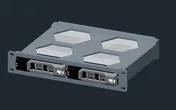
The dual 3.5-inch HDD mount takes two caddies in 1U at 198 mm deep. That fits all six RackMate frames, including the 200 mm T0 and T1, though in those two the mount uses almost the full depth and leaves very little room behind it for cabling. The 260 mm frames give the rear connections more breathing space.
The size figures deserve a caveat. The caddy’s 111.3 × 190.1 × 29.7 mm and the mount’s 106.6 × 27.0 mm openings were measured from CAD models, not taken from a Dell drawing. Treat them as planning numbers, check your exact caddy revision against the mount’s source page and allow for print tolerances. For reference, the 3.5-inch drive envelope itself is 101.6 mm wide, up to 147 mm long and up to 26.1 mm high for the 1-inch class, per SFF-8301.
The drive in the model is a placeholder. Its capacity and power are not specified, and the label artwork on the render is not a spec. Plan around the drive you actually buy.
Power
There are no power figures here, and that is deliberate. The caddy itself is passive, but the model includes an unspecified 3.5-inch hard drive, and an unknown drive is not zero watts. The catalogue leaves both the low and high figures blank rather than invent them.
For a rack power budget, take idle, active and spin-up figures from your own drive’s datasheet and count them twice for each dual mount. Spin-up is the one that bites: several drives starting at once draw well above their running figure, and whichever supply feeds them has to cover it.
Networking and cabling
The caddy has no network ports. Its data path is SAS or SATA, from the drive’s connector at the back of the tray to a controller in the host. The retailer listing notes that the tray is not for use with a SATA interposer, and SAS drives need a SAS-capable controller; a plain SATA port will not run them.
Keep that cabling inside the rack, from the back of the mount to the host, and check the mount’s source page for the SATA hardware it expects. Network traffic then runs through the host’s own ports, so cable those by the host’s rules.
How it differs from the Dell 2.5-inch caddy
The Dell 85PPW 2.5-inch caddy is the small-form-factor sibling, and the two differ in more than drive size:
- Contents: the 85PPW is modelled empty, so it counts as 0 W; this caddy includes an unspecified hard drive with unknown power.
- Drives: 2.5-inch SAS or SATA drives up to 15 mm thick, against one 3.5 × 1-inch drive.
- Mount: the dual 2.5-inch SSD mount is 0.5U and 144 mm deep, against 1U and 198 mm. Both fit all six frames.
- Servers: the 85PPW lists PowerEdge MX and XR models, this tray the 13th-generation R and T lines.
Full specifications
Plan it
Open the Dell 3.5-inch caddy in the catalogue and drop two into the dual 3.5-inch HDD mount, or start from a community build that already uses it:
For flash storage, read the Dell 2.5-inch caddy guide; for a self-contained NAS, the UGREEN DXP4800 guide.
Sources
Related guides
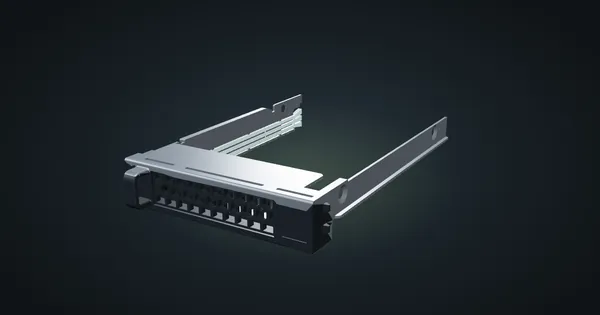
Dell 85PPW 2.5-inch caddy in a 10-inch rack
The Dell 85PPW 2.5-inch drive sled in a 10-inch rack: two per printed half-unit hot-swap mount, 144 mm deep, SAS or SATA drives up to 15 mm.
Intel 520-series 2.5″ SSD in a 10-inch rack
The Intel 520-series 7 mm SATA SSD in a 10-inch rack: storage for the printed Raspberry Pi NAS plates, 0.85 W typical active, and full specs.
Dell Pro Max GB10 in a 10-inch rack
Dell's GB10 system in a 10-inch rack: a 280 W USB-C adapter, M.2 2230 or 2242 storage up to 4 TB, the shared 1.5U mount and rear 10GbE and QSFP.