Gigabyte AI TOP ATOM in a 10-inch rack
Gigabyte's GB10 box in a 10-inch rack: a 4 TB PCIe 5.0 SSD option, DGX OS or Ubuntu, the shared 1.5U mount, a 240 W adapter and rear 10GbE plus QSFP.
On this page
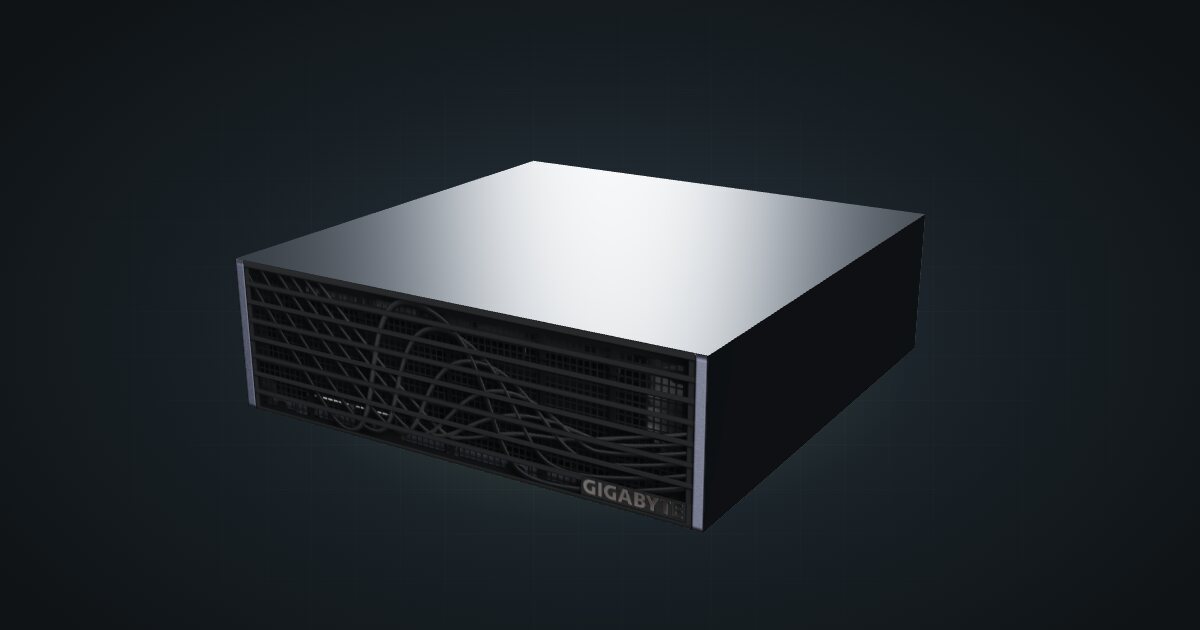
The Gigabyte AI TOP ATOM is Gigabyte’s take on the NVIDIA GB10: a 20-core Arm CPU and a Blackwell GPU sharing 128 GB of memory, in a 1 L chassis with the same outside dimensions as the DGX Spark. What sets it apart is the storage menu, which includes a PCIe 5.0 SSD, and an operating system line that lists Ubuntu Linux next to DGX OS. It suits local AI work where datasets and checkpoints are as big a concern as the model itself.
At a glance
| CPU | NVIDIA GB10 Grace Blackwell, 20-core Arm (10 × Cortex-X925 + 10 × Cortex-A725) |
| Memory | 128 GB LPDDR5x unified memory, 256-bit, 273 GB/s |
| AI performance | 1 petaFLOP |
| Storage | 4 TB M.2 NVMe (PCIe 5.0 or PCIe 4.0) or 1 TB PCIe 4.0, by SKU |
| Networking | 10GbE RJ45, 2 × QSFP 200 Gbps (ConnectX-7), Wi-Fi 7 |
| Software | NVIDIA DGX OS, Ubuntu Linux |
| Size and power | 150 × 150 × 50.5 mm, 1.2 kg, 240 W external adapter |
Where it fits in a mini rack
Like the DGX Spark, the ATOM is built around one pool of 128 GB that CPU and GPU share, at 273 GB/s over a 256-bit bus. That pool is what lets a box this size hold large language models whole, which is the reason to rack one at all.
The jobs it suits:
- A local inference server. Load a large model once and serve it over the 10GbE port to the rest of the homelab: chat, code completion, summarising documents from the NAS, or a private assistant for home automation.
- Fine-tuning on your own data. Gigabyte rates the GB10 at 1 petaFLOP. Treat that as the chip’s peak, not what a given training run will see. Where the ATOM differs is the 4 TB PCIe 5.0 SKU: training runs read datasets and write checkpoints constantly, and a faster SSD helps there.
- One node of two. The ConnectX-7 adds two QSFP ports at 200 Gbps for a direct link to a second GB10 system when one memory pool runs out.
What it is not: a general-purpose virtualization host, a NAS or a gaming PC. The Arm cores and DGX OS make it a dedicated AI appliance, and the single SSD is working space, not bulk storage.
How it fits a 10-inch rack
The configurator checks every placement against each rack in the catalogue:
On paper the ATOM measures 150 × 150 × 50.5 mm, matching the published dimensions of the DGX Spark, and the catalogue lists the shared GX10 / DGX Spark mount for it. That mount holds it horizontally in 1.5U at 154 mm deep and fits every RackMate frame, from the four-unit T0 at 200 mm to the 260 mm frames. Nothing is blocked.
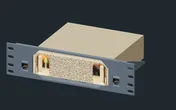
The 10i hex shelf is the alternative: flat in 2U or upright in 4U, at 155 mm deep. Upright takes all four units of a T0 or T0 Plus, so flat is the better choice in the small frames.
Power
Gigabyte documents a 240 W external adapter and no idle or full-load figure. The catalogue uses that 240 W rating as a planning allowance: a ceiling for budgeting, not measured draw, and it does not include adapter losses.
Budget 240 W per ATOM on the power strip and UPS. NVIDIA publishes idle and maximum figures for its own Spark, but those apply to the DGX Spark, not automatically to every GB10 system, so do not borrow them for this one. The adapter plugs into a rear Type-C port that Gigabyte lists as PD in; leave room behind the mount for that cable and park the brick on the rack floor or a rear shelf.
Networking and cabling
All wired networking is at the rear: one 10GbE RJ45 jack (LAN 1) and two QSFP cages (QSFP 1 and QSFP 2) on the ConnectX-7 at 200 Gbps.
- Patch LAN 1 to a rear keystone and pick it up from the front of the panel. Never route a cable around the side of the rack to a front switch port. A 10G copper switch port gets the full speed.
- The QSFP cages take direct-attach copper cables or optical modules, which makes a short DAC the obvious link between two GB10 systems in the same rack.
- Wi-Fi 7 and Bluetooth 5.4 are on board, but a rack wants the wire.
The rear also carries three USB 3.2 Gen 2x2 Type-C ports at 20 Gbps next to the power-in port, plus one HDMI 2.1a output for a console.
How it differs from the NVIDIA DGX Spark
On a spec sheet the ATOM sits very close to the reference. The differences are small but real:
| Gigabyte AI TOP ATOM | NVIDIA DGX Spark | |
|---|---|---|
| Storage | 4 TB PCIe 5.0 or PCIe 4.0, or 1 TB PCIe 4.0 | 1 TB or 4 TB with self-encryption |
| Software | NVIDIA DGX OS, Ubuntu Linux | NVIDIA DGX OS |
| Chassis | 1 L, Kensington Nano slot on the side | NVIDIA reference chassis |
| Size and weight | 150 × 150 × 50.5 mm, 1.2 kg | 150 × 150 × 50.5 mm, 1.2 kg |
| Power adapter | 240 W external | 240 W external, included |
| Video | 1 × HDMI 2.1a listed | HDMI 2.1a plus up to 3 × DisplayPort over USB-C |
| Operating temperature | Not listed | 5–30 °C (ideal range) |
Gigabyte’s spec sheet does not mention self-encryption for its drives, and it lists no operating temperature or cooling details, so ask before you buy if either matters. For rack planning, the two boxes are interchangeable: same footprint, same mount, same 240 W allowance.
Full specifications
Plan it
Open the Gigabyte AI TOP ATOM in the catalogue to add it to a rack plan with the mount or shelf above. No community build uses it yet.
The NVIDIA DGX Spark guide covers the reference design and the rest of the family, and the ASUS Ascent GX10 guide covers the other GB10 system with a PCIe 5.0 SSD option.
Sources
Related guides
NVIDIA DGX Spark in a 10-inch rack
NVIDIA's GB10 reference box in a 10-inch rack: 128 GB unified memory, a 1.5U mount, rear 10 GbE and 200 Gbps QSFP, and a 240 W power budget.
Dell Pro Max GB10 in a 10-inch rack
Dell's GB10 system in a 10-inch rack: a 280 W USB-C adapter, M.2 2230 or 2242 storage up to 4 TB, the shared 1.5U mount and rear 10GbE and QSFP.
Lenovo ThinkStation PGX in a 10-inch rack
Lenovo's ThinkStation take on GB10 in a 10-inch rack: reference-size chassis, self-encrypting storage up to 4 TB, the 1.5U mount and a 240 W adapter.