Lenovo ThinkCentre M710q Tiny in a 10-inch rack
How the ThinkCentre M710q Tiny fits a 10-inch rack: the M910q's budget sibling on B250, no vPro, no PCIe slot, a rear Gigabit port and two 1U mounts.
 Mica Voss@micavoss5 min read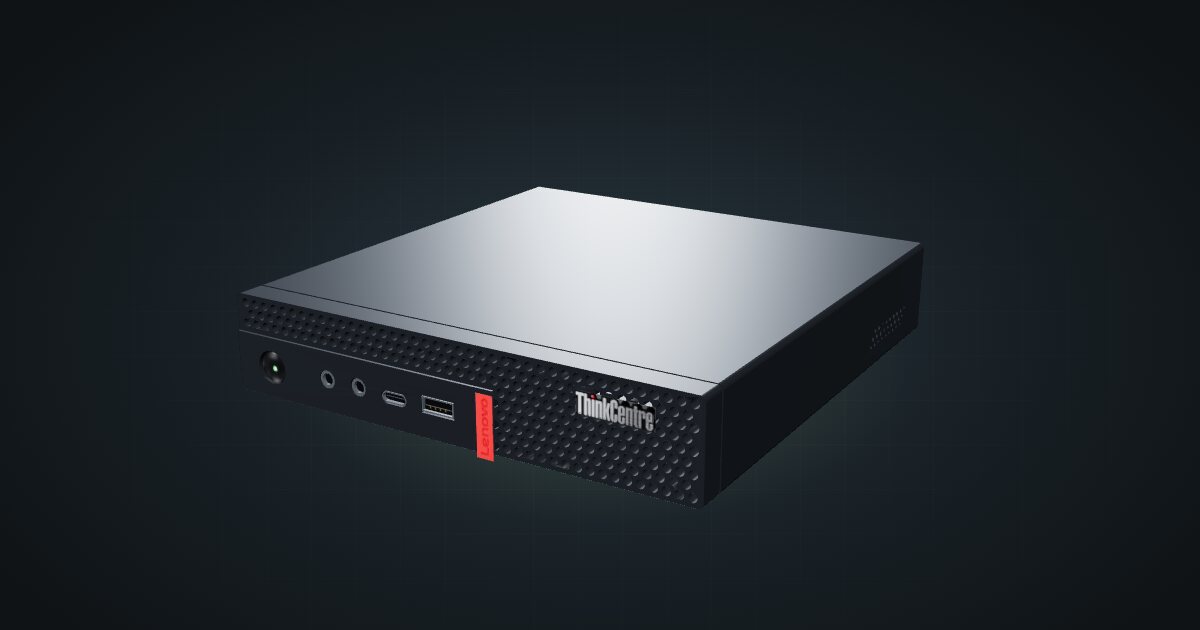
On this page
The ThinkCentre M710q Tiny is the budget sibling of the M910q: the same 179 × 183 × 34.5 mm chassis and the same 6th and 7th Gen Intel T-series CPUs, but Intel’s B250 chipset instead of Q270 and no vPro. It has no PCIe slot either, so it is a compact compute node rather than a router-card host. It sold in volume to offices that never needed remote management, which makes it one of the most common Tinys on the used market and a cheap way to fill a rack with identical x86 nodes.
At a glance
| Processor | Celeron, Pentium or 6th/7th Gen Core T-series, up to Core i7-7700T (4 cores / 8 threads, up to 3.8 GHz); configurable |
| Memory | 2 × DDR4-2400 SO-DIMM, dual-channel, 32 GB maximum |
| Storage | M.2 PCIe 3.0 x4 NVMe SSD plus one 2.5-inch SATA drive |
| Networking | One Gigabit RJ45 (Intel I219-V) at the rear, Wake-on-LAN |
| Management | None; no Intel AMT or vPro |
| Power | External 65 W adapter; 90 W only with the optional I/O box |
| Size and weight | 179 × 182.9 × 34.5 mm, 1.32 kg |
Where it fits in a mini rack
For a small Proxmox, Docker or Kubernetes node, the M710q offers the same hardware as the M910q: up to 4 cores / 8 threads, two SO-DIMM slots for up to 32 GB, and an NVMe drive plus a 2.5-inch drive so the operating system and the data can live on separate disks. Three or four identical units stack one per unit of rack height, and the low used price is what makes such a cluster affordable.
The 7th Gen models are the ones to look for. Lenovo’s spec sheet pairs them with Intel HD Graphics 630, and Intel lists Quick Sync Video for the Core i7-7700T, so a Jellyfin or Plex container can hand transcoding to the GPU. The 6th Gen models carry HD Graphics 530, so check the CPU before you plan on media duty.
Non-vPro means no Intel AMT: Lenovo’s spec sheet lists manageability as none, so there is no built-in remote power control or console. If the rack sits in a cupboard, plan for a KVM over IP device alongside it.
What it is not: a router build, because without a PCIe slot there is no room for a four-port network card, and not a storage server, with two drives at most.
How it fits a 10-inch rack
The configurator checks each placement against every rack in the catalogue:
The M710q shares the M920q’s envelope and rear connector order, so both of the catalogue’s ThinkCentre mounts take it in 1U and fit all six RackMate frames: the demo mount is 188 mm deep and the M920q mount v2 is 187 mm. In the 200 mm-deep T0 and T1 that leaves little room for the rear plugs, so the 260 mm frames are the more comfortable choice.
Rack height: 1U · Depth: 106.5 mm · Mounting: 3D-printed 1U carrier
Details & sources →
Rack height: 1U · Depth: 186.5 mm · Mounting: 3D-printed 1U carrier
Details & sources →- ThinkCentre M920q mount v2 is a community mount drawn for the M920q chassis.
- ThinkCentre demo mount comes from a parametric 10-inch mount design and is a starting point if you want to adapt it.
Both mounts are drawn around the M920q, whose front ports differ from the M710q’s, so check any faceplate cut-outs against your machine before you print.
Without a mount, the 10i hex shelf takes the machine flat in 1U at 187 mm deep. Standing upright it needs 5U, so the upright option only works in the T1, T1 Plus, T1/2 Plus and T2.
Outside the catalogue, the community 10 Inch Rack Mount for Lenovo m910q on Printables is drawn for the M910q, which shares this chassis. It is not in the configurator yet.
Power
The catalogue plans this machine between 11 W and 90 W. The low figure is ServeTheHome’s measured idle of 11-13 W on a quad-core M710q Tiny at 120 V. It is a reference for a unit at rest, not a guarantee under load, and ServeTheHome published no maximum figure.
The high figure is 90 W, the largest documented adapter, and it is not measured consumption. Lenovo ships a 65 W adapter, 88% efficient, as standard; the 90 W adapter comes only with the optional I/O box. For rack planning, budget 65 W per standard machine, size a UPS from the adapters rather than the idle figure, and find a home for each external brick behind the mounts or on the rack floor.
Networking and cabling
The onboard port is a single Gigabit RJ45 on an Intel I219-V, with Wake-on-LAN, and it faces the rear. Patch it to a rear keystone in the same rack rather than routing the cable around the frame to the front.
The front panel has two USB 3.1 Gen 1 ports, one of them always on, which is enough for a boot stick and a keyboard. The rear adds four more USB 3.1 Gen 1 ports and two DisplayPort outputs. Wi-Fi is an optional M.2 card, and in a rack you will rarely want it.
How it differs from the M910q and M920q
The M710q uses the M920q’s 3D model and mounts and shares the M910q’s processors, memory and storage layout. The differences are in the platform:
| M710q | M910q | M920q | |
|---|---|---|---|
| CPU ceiling | Core i7-7700T, 4 cores / 8 threads, up to 3.8 GHz | Core i7-7700T, 4 cores / 8 threads, up to 3.8 GHz | Core i9-9900T, 8 cores / 16 threads, up to 4.4 GHz |
| Memory | DDR4-2400, 32 GB max | DDR4-2400, 32 GB max | DDR4-2666, 32 GB max (Lenovo-tested) |
| Expansion | No PCIe slot | No PCIe slot | PCIe 3.0 x8 low-profile slot, optional I350-T4 card |
| Ethernet | Intel I219-V | Intel I219-LM | Intel I219-LM |
| Platform | B250, no AMT | Q270, AMT 11.0, vPro on selected models | AMT 12.0, vPro on selected models |
| Bluetooth | 4.1 | 4.2 | 4.2, or 5.0 with the Intel 9560 card |
| Adapters | 65 W; 90 W with the I/O box | 65 W; 90 W with the I/O box | 65 W, 90 W or 135 W |
| Measured idle | 11-13 W on a quad-core unit | None published | 12-15 W on a quad-core unit |
Pick the M920q for router builds or more cores, and the M910q if you want AMT on a budget. The M710q does the same rack job as the M910q at the lowest price of the three, which makes it the one to buy in threes for a cluster.
Full specifications
Plan it
Open the ThinkCentre M710q Tiny in the catalogue to add it to a rack plan.
The ThinkCentre M910q guide covers the vPro sibling, the ThinkCentre M920q guide covers the newer machine compared above, and the ThinkCentre M720q guide covers the newer non-vPro Tiny with the PCIe slot.
Sources
Related guides
Lenovo ThinkCentre M910q Tiny in a 10-inch rack
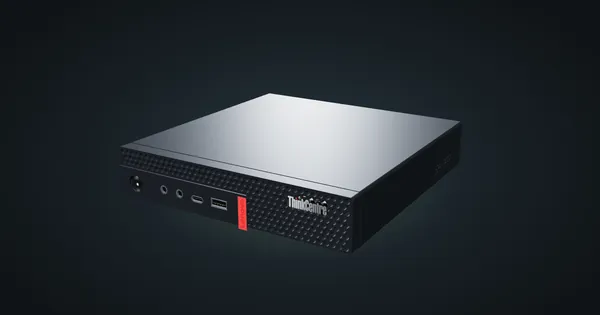
How the ThinkCentre M910q Tiny fits a 10-inch rack: 6th/7th Gen Intel on Q270, vPro on some models, no PCIe slot, a rear Gigabit port and two 1U mounts.
Lenovo ThinkCentre M720q Tiny in a 10-inch rack
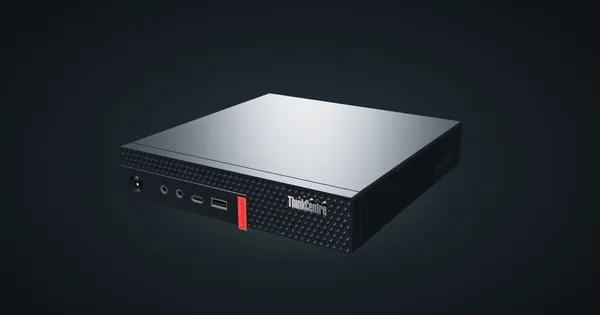
How the ThinkCentre M720q Tiny fits a 10-inch rack: the M920q chassis on B360, a PCIe 3.0 x8 slot, a rear Gigabit port and two 1U mounts.
Lenovo ThinkCentre M920q / M920x in a 10-inch rack
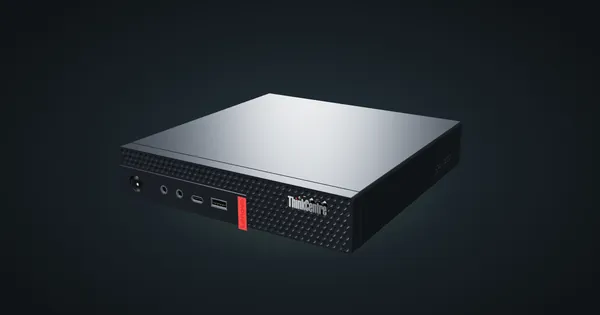
How the ThinkCentre M920q and M920x fit a 10-inch rack: two 1U mounts, a rear Gigabit port, up to 32 GB RAM and 65 W to 135 W adapters.