Ubiquiti UniFi Switch Ultra in a 10-inch rack
Ubiquiti UniFi Switch Ultra in a 10-inch rack: seven PoE+ ports, a rear PoE++ input, a supply-dependent PoE budget and a tight 1U shelf fit.

On this page
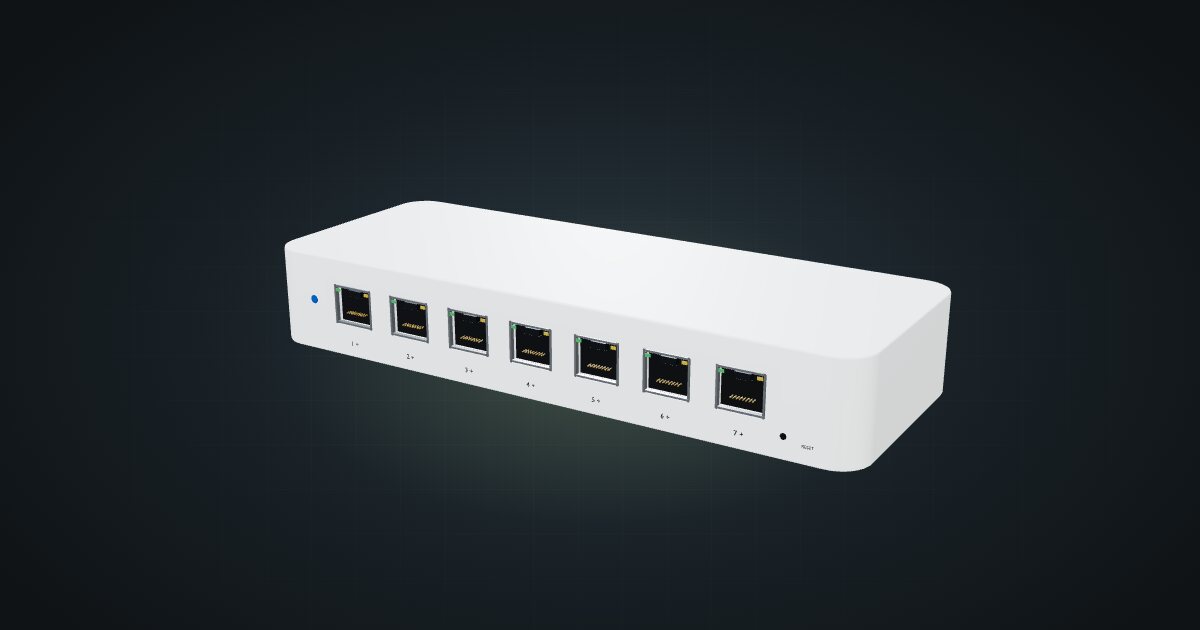
The Ubiquiti UniFi Switch Ultra is a compact eight-port Gigabit switch with an unusual layout: seven PoE+ ports on the front and an eighth port at the back that takes PoE++ in. It is managed from UniFi Network and can run from an adapter or from an upstream PoE++ source. It suits a mini rack that needs to power a few cameras or access points without giving up much space.
At a glance
| Ports | 8 × Gigabit RJ45: ports 1–7 on the front, port 8 at the rear |
| PoE output | Ports 1–7, PoE+ up to 30 W per port within the total budget |
| PoE input | Rear port 8, PoE++ |
| PoE budget | 42 W via PoE++, 16 W via PoE+, 52 W with the 60 W adapter, 202 W with the 210 W adapter |
| Management | UniFi Network |
| Switching capacity | 16 Gbps |
| Size and weight | 203 × 76 × 33 mm, 320 g |
Where it fits in a mini rack
The Ultra is a PoE switch for small installations. Seven PoE+ ports are enough for a handful of cameras feeding an NVR in the same rack, or for access points and PoE-powered boards, and UniFi Network shows them alongside the gateway and the rest of the network.
Its trick is the rear PoE++ input. Feed port 8 from an upstream PoE++ source and the Ultra needs no adapter of its own, which is handy for a rack at the far end of a single cable. The trade-off is a smaller PoE budget, so the input you choose decides how many devices it can power.
What it is not: a fast switch. Every port is Gigabit and the switching capacity is 16 Gbps, so a multi-gig NAS link has to go elsewhere. It also ships without a mount or a power adapter, so plan both.
How it fits a 10-inch rack
There is no dedicated community mount for the Ultra. The catalogue places it on the hex shelf, and the configurator checks each option against every rack:
- Flat on the 10i hex shelf takes 1U, counting the shelf deck, at 154 mm deep, and fits every RackMate frame from the 200 mm deep T0 and T1 to the 260 mm frames.
- Upright on the hex shelf needs 5U. That fits the T1/2 Plus, T1, T1 Plus and T2, and is blocked in the four-unit T0 and T0 Plus: there are not enough units.
Flat is the obvious choice: one unit, every rack.
The flat fit is tight. The Ultra is 203 mm wide and leaves only 3.25 mm of total width clearance on the shelf, so there is no room for anything beside it and little for error.
Power
The switch itself is rated at 9 W maximum on PoE input or 8 W on a DC adapter, both excluding PoE output. The catalogue plans with 9 W. No idle figure is published.
The PoE budget is a separate number, and it depends on the supply. Fed over PoE++ on port 8, the budget is 42 W; over PoE+, 16 W. With the 60 W AC adapter it is 52 W, and with the 210 W AC adapter it rises to 202 W, for a total maximum of 210 W. Neither adapter comes in the box. Each front port can deliver up to 30 W within whichever budget applies.
For rack planning, count each PoE device’s draw once: as part of the Ultra’s PoE output or as that device’s own load, never both. If the Ultra itself runs on PoE++, its draw belongs to the upstream source’s budget.
Pick the power source from the PoE load, not the other way round. Add up what the powered devices need first, then choose the input whose budget covers it: 42 W over PoE++, 52 W or 202 W with an adapter.
Networking and cabling
Unlike most small switches, the Ultra has ports on both faces, so the cabling rule matters:
- Ports 1–7 face the front. Patch them to front-facing ports on devices in the same rack, or to front keystones. For a device whose Ethernet port faces the rear, patch the switch to a front keystone and connect the device’s rear port to the rear of that keystone.
- Port 8 faces the rear. It goes to a rear keystone; the upstream PoE++ source or uplink connects to the front of that keystone.
- Never route a cable around the rack to get from one face to the other.
All eight sockets take cables, and port 8 is a Gigabit port like the rest, so on PoE power the same rear cable brings both the uplink and the power. The MAC table holds 4,000 entries and jumbo frames are supported.
How it differs from the UniFi Flex 2.5G PoE
The UniFi Flex 2.5G PoE is the bigger UniFi PoE switch in the catalogue:
- Speed. Eight 2.5 GbE ports, a 10G combo uplink (RJ45 or SFP+) and 60 Gbps of switching capacity, against 8 × Gigabit and 16 Gbps here.
- PoE. PoE++ on all eight ports, up to 64 W per port, with a 196 W budget on the 210 W adapter. The Ultra offers PoE+ on seven ports, up to 30 W each.
- Power input. Both take 50–57 V DC or PoE; the Flex takes PoE+++ on its front 10G RJ45, the Ultra PoE++ on rear port 8.
- Fit. The Flex is 212.9 mm wide, too wide for the shelf flat, and needs 5U upright. The Ultra fits flat in 1U.
Full specifications
Plan it
Open the UniFi Switch Ultra in the catalogue to place it on the hex shelf, or start from a community build that already uses it:
For more PoE and faster ports, read the UniFi Flex 2.5G PoE guide. For PoE outside UniFi, the NETGEAR GS308EP guide covers an Easy Smart managed alternative.
Sources
Related guides
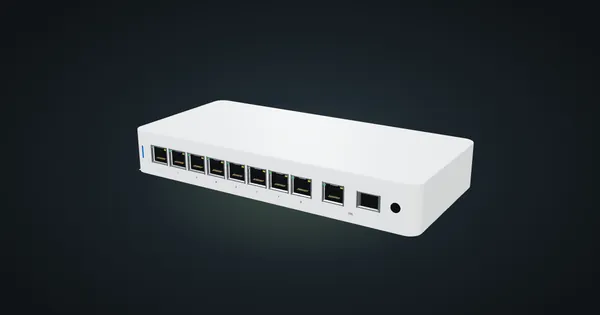
Ubiquiti UniFi Flex 2.5G PoE in a 10-inch rack
Ubiquiti UniFi Flex 2.5G PoE in a 10-inch rack: eight 2.5 GbE PoE++ ports, a shared 10G uplink, a 196 W PoE budget and an upright-only 5U fit.
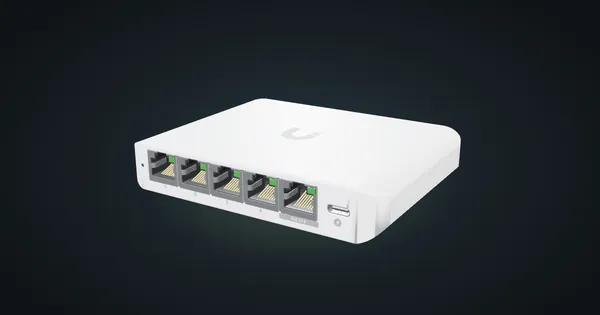
Ubiquiti UniFi Flex Mini 2.5G in a 10-inch rack
Ubiquiti UniFi Flex Mini 2.5G in a 10-inch rack: five 2.5 GbE ports, USB-C or PoE power, 6.4 W maximum and a 94 mm deep 1U community mount.
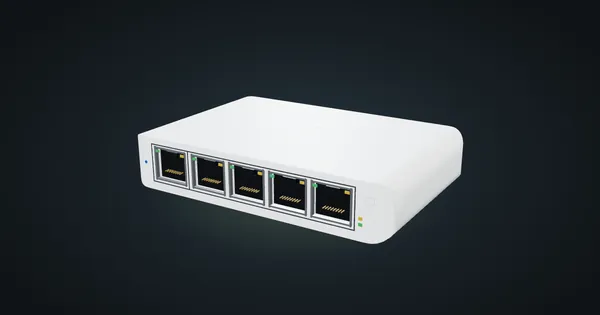
Ubiquiti UniFi Flex Mini in a 10-inch rack
Ubiquiti UniFi Flex Mini in a 10-inch rack: five Gigabit ports, USB-C or PoE power, 2.5 W maximum draw and a 74 mm deep 1U community tray.